
FAQ
LTC
What is LTC?
Leave Travel Concession is nothing but a type of salary component where your employer is
providing some yearly benefit to travel with your family
Can I book a private flight?
Yes Private Airlines is eligible. However, in terms of the latest Office Memorandum No.19024/03/2021-E. IV dated 16.02.2022 issued by the Ministry of Finance, Department of Expenditure, GoI- the air travel on Government account both Domestic (including LTC) and International travel can be made by private airlines and that in all cases of air travel where the Government of India bears the cost of air passage, air tickets shall be purchased from the three Authorized Travel Agents viz.,:
a) M/s. Balmer Lawrie & Company Limited (BLCL)
b) M/s. Ashok Travels & Tours (ATT)
c) Indian Railways Catering and Tourism Corporation Ltd. (IRCTC)
Can I use my private car for my travel and how should I submit my claim?
Reimbursement for the purpose of LTC shall be admissible in respect of journeys performed in vehicles operated by the Government or any Corporation in the public sector run by the Central or State Government or a local body.
In case of journey between the places not connected by any public/Government means of transport, the Government servant shall be allowed reimbursement as per his entitlement for journey on transfer for a maximum limit of 100 Kms covered by the private/personal transport based on a self-certification from the Government servant. Beyond this, the expenditure shall be borne by the Government servant.
The expression 'Public Transport" means all vehicles, including trains and airplanes operated by the Tourism Development Corporations in the Public Sector, State Transport Corporations and Transport services run by other Government or local bodies.
Shall i maintain minimum "EL leave" balance during LTC - for EL encashment?
My hometown declared to Administration is Chennai. Can I avail Home Town conversion?
No. Employees whose Home Town & Headquarters are same are not eligible for Home Town LTC and hence, the question of conversion of Home Town LTC to travel to the places under special concession scheme does not arise
The general quota train tickets have been completely booked off. Can I book Tatkal tickets for LTC?
Travel by Premium trains/Premium Tatkal trains/Suvidha trains is now allowed on LTC. Further, reimbursement of tatkal charges or premium tatkal charges shall also be admissible for the purpose of LTC.
What is the eligibility for extending a lapsed LTC Block year?
The LTC admissible for a particular BLOCK of TWO years (Home Town), if NOT availed of during that block, may be availed of in the FIRST YEAR ( Grace period) of the NEXT FRESH TWO YEAR BLOCK.
For my LTC, I had performed my onward travel before the expiry period of the block year but my return was performed only after the expiry period. Will it affect my block period? i.e., have I consumed my eligibility next block as well?
No. The LTC availed of will be counted only against the block of two years or four years within which the outward journey commenced, even if the return journey was performed after the expiry of the block of two years or four years.
I am a new recruit. Do I have any special scheme under LTC? Or what is my eligibility?
Yes. There is a special scheme for new recuits with the eligibility starting from the date of completion of one year of regular service. This scheme runs till the eighth calendar year from the date of eligibility with Home Town travel concession during the 1st, 2nd, 3rd, 5th, 6th, 7th year and anywhere in India travel eligibility during the 4thand 8thyear. There shall no carry forward of unavailed concession during these 8 years.
| 1st Year of service | Not eligible | 2nd year | Hometown |
| 3rd Year | Hometown | 4th year | Hometown |
| 5th year | Anywhere India / Hometown | 6th Year | Hometown |
| 7th Year | Hometown | 8th Year | Hometown |
| 9th Year | Anywhere India / Hometown | ||
Please refer the link https://dopt.gov.in/sites/default/files/31011_7_2013-Estt.A-IV-26092014.pdf
FAQ
Faculty Related
What is CPDA?
Cumulative Professional Development Allowance
It's applicable only for faculties.
Limit: Rs. 3 lakhs for a block year (3 years) and it should be utilized only for official purpose.
What is Sabbatical Leave?
Sabbatical Leave may be granted for one or more of the following objects, namely :-
1. to conduct research or advanced studies in India or abroad;
2. to write text books, standard works and other literature;
3. to visit or work in industrial concerns and technical departments of Government to gain practical experience in their respective fields;
4. to visit or work in a University, Industry or Government research laboratory in India and abroad; and
5. any other purposes for the academic development of the staff member, as approved by the Board of Governors.
What are the leave rules during the re-employment period?
Leave Rules:
Eligible for Casual Leave at the rate of 8 days per calendar year to be granted proportionately.
Eligible for Earned leave at the rate of 2½ days per every completed calendar month. This EL
cannot be encashed.
Not entitled to avail vacation during the period of re-employment
How many types of Vacation applicable to faculties?
Two vacations available for faculties
a) Summer = Mid May to Mid July
b) Winter = 1st week of December to 1st week of January
What is re-employment and how it is done?
Faculty members who superannuate post-commencement of an academic year i.e., after 01stJuly, may be approved for re-employment by the Director upto 30thof June of the next year(end of the particular academic year).
1. The services and conduct will be governed by the Act & Statutes of the Institute and any other administrative orders and rules in force from time to time at this Institute in addition to those, which are specifically mentioned hereunder.
2.The Office Order for fixing the pay on re-employment will be issued separately on receipt of joining report through the HOD.
3. Leave:
a. Eligible for Casual Leave at the rate of 8 days per calendar year to be granted proportionately.
b.Eligible for Earned Leave at the rate of 2½ days per every completed calendar month. This EL cannot be encashed.
c.Not entitled to avail vacation during the period of Re-employment.
4. Eligible to retain the quarters during the Re-employment period as per Estate Rules.
5. Eligible for medical facilities and Library facilities as applicable to permanent faculty.
6. Not eligible for facilities of permanent benefits viz. provident fund, LTC etc. during the re-employment period.
7. Not eligible for Institute financial assistance for attending conferences in India or abroad.
8. The services on Re-employment will be terminated on either side with one month prior notice
FAQ
Leave Rules
Whether the government servant can claim the leave as a matter of right?
No. The Sanctioning Authority may accept (or) refuse the leave request. However Earned Leave should not ordinarily be denied during the last 10 years. [DOPT OM 14028/19186-Estt.(L)] dated. 29.09.1986, Rule 7. Gid(2).
What is the maximum period allowed for maternity leave?
Maximum 180 days from the date of its commencement for employees with less than surviving 2 children. Rule 43(1).
Any leave up to a maximum of 2 years is allowed without production of medical certificates in continuation of maternity leave (Commuted leave up to 60 days). Rule 43(4) (a) 8 (b).
Is any special concession for child care leave towards children with disabilities?
CCL in the case of child with disability will be granted to an offspring of any age.
The age limit of 22 years is withdrawn [OM dated 22.06.2018].
Can male Government Servant avail CCL?
Yes. A single male parent can avail CCL.
Is Causal Leave a recognition leave?
CL is not subject to any rules of Government of India. Hence it is not a recognised leave.
CL can be combined with vacation/Special Casual Leave, but not with any other leave.
CL can be taken for half day also LTC can be availed during CL.
Maximum limit 8 days & Maximum number of CL to be availed at a time is 5 days For Government servants with disabilities additional 4 days as special causal leave. [OM dated. 19.11.2008]
Whether paternity leave is allowed after date of delivery of the child?
Yes. Paternity leave is allowed up to 15 days before (or) up to 6 months after date of delivery.
Paternity leave is to be taken 15 days in one spell.
What is the minimum period for CCL?
CCL less than 5 days at a time may not be granted.
CCL shall not be granted for more than 3 spells in a calendar year, In case of a single female government servant, the grant of leave shall be extended to 6 spells in a calendar year.
Whether LTC can availed during CCL?
Yes. DOPT OM 13018/6/2013. Estt.(L) dated. 03.04.2018
FAQ
Estate
What is “ineligible period” for quarters if he move out of campus?
The staff member who vacate the quarters and move out of campus is ineligible for campus housing for two years
What is debar clause?
As and when the eligible quarters are announced, the announcement will have a closing date for registration followed by a period of two working days for withdrawals / cancellations. All withdrawals / cancellations of registration and declining of allotments after the withdrawal deadline, irrespective of whether allotment order has been issued or not, will result in debarring from quarters allotment / registration for one year from the date of closing date of the particular announcement.
What is the Notice period for vacating the quarters?
An allottee shall, before vacating the residence, give not less than 7 days’ notice in writing to the Registrar.
From When the licence fee will be calculated?
The liability for licence fee shall commence from the date of occupation of the residence or 10th day from the date of receipt of allotment order whichever is earlier
What is the eligibility for allotment of quarters?
The Grade Pay / level in the determining factor for allotment of quarters.
In case death of staff member, how long their family retain the quarters?
In the event of the death of a staff member, his/her family can retain the quarters to a maximum period of two years as per GOI norms.
What are the Standard Charges deducted under Estate Recoveries, if occupied the quarters?
Licence Fee - Depends upon the Sq.ft.
Electricity Charges - As per consumption
Water Charges - Flat rate as fixed from time to time
Solid Waste Disposal - Fixed by the Institute
Service Charges - As per Govt. Norms
What is Retention of Quarters?
The staff members retiring from services on superannuation or voluntary retirement or after the deputation period at the Institute would be permitted to retain the quarter’s upto the eligible period of Govt norms.
| First 2 months | Normal Licence Fee |
| Subsequent 2 months | Rs.6 / Sq.ft |
| Further subsequent 2 months | Rs. 12 / Sq.ft. |
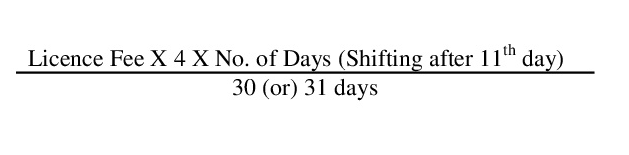
How the penalty calculated for delay in shifting?

FAQ
Insurance
How to send reimbursement claims to Insurance Cell, Administration Section?
Reimbursement claims can be submitted to the Insurance Cell at 2nd Floor of IITM’s Administration block through registered post /courier or handed over in person.
Can I claim medical expenses incurred before and after the hospitalization?
You can claim medical expenses incurred 30 days before and 60 days after hospitalization provided they are related to the ailment/accident for which you were hospitalized. Such expenses are termed as pre and post hospitalization.
Are there any limitations for claiming under health insurance plan?
There is no limit to the number of claims per policy period but there is a limit to the amount that you can claim in a year. The maximum amount that you can claim in a year is limited to the sum/enhanced insured.
Is there a minimum time limit for stay within the hospital under the health insurance plan?
Typically, the insured can make a claim if he/she is hospitalized for over 24 hours. However, for certain treatments (Please refer our current policy terms and conditions), the stay could be less than 24 hours.
What are the documents required if the insured dies at the time of treatment?
Indemnity Bond as prescribed by the Insurance Company along the claim form and necessary documents listed under Q.No.8 to Insurance Cell, Admin within 20 days from the date of discharge.
What is Mediclaim?
Mediclaim Insurance is a cover, which takes care of the hospitalization expenses subject to maximum sum insured of the Insured employee/pensioner/dependents in respect of the following situations:
In case of a sudden illness.
In case of an accident.
In case of any surgery, this is required in respect of any disease, which has arisen during the policy period.
Can I claim my dentist's bills?
No, it’s not covered as per our policy terms and conditions except issue araised during major accident.
Are all the diagnostic tests prescribed by the doctor at a hospital reimbursed under the Health Insurance Plan?
Expenses incurred at a hospital or a nursing home for diagnostic purposes such as X-rays, blood analysis, ECG, etc. will be reimbursed if they are related to the ailment for which the policy-holder has been hospitalized. In any other scenario, these expenses cannot be claimed.
Who will receive the claim amount if the insured dies at the time of treatment?
The claim amount is paid to the registered nominee of the insured.
What is Co-payment?
Co-payment is a charge for the services by TPA in processing claims to the Insurance Company in the case of hospitalization in non-network hospitals. Certain percentage applicable as per the policy terms and conditions on payable amount which the policy-holder has to bear in the case of hospitalization in non-network hospitals.
FAQ
NPS
What is NPS?
National Pension Scheme is a defined contribution based scheme that is introduced by the government with the objective of extending the old age security coverage to all the citizens who opt out for this scheme. You will be given reasonable market-based returns under NPS over the long run. By investing in NPS you are bound to receive old age income.
Who can invest in NPS?
All the State and Central Government employees, as well as citizens of India that fall between the age group of 18 to 60 years, are eligible for investing in the NPS. The pre-existing pension account holders can also apply under this scheme for fresh registration.
How does NPS Work?
NPS is based on a unique Permanent Retirement Account Number (PRAN) which will be allotted to you (subscriber) when you join this scheme. Exercising their executive powers, the Government of India adopted the NPS in respect of all the new entrants, with effect from 1st January 2004, to Central Government services, except the Armed Forces. Ever since a similar pension system has been notified by most of the State Governments for the new entrants. The Pension Fund Regulatory and Development Authority (PFRDA) has made NPS available for all the citizens of India on a voluntary basis, with effect from 1st May 2009.
You can join the NPS Scheme on your own or can use the one offered by your employer. If your employer is offering NPS, he will make an equal contribution from his side in the scheme. Also, you will be liable for additional tax benefit over employer’s contribution towards this scheme.
The scheme pools your savings in a pension fund and PFRDA regulated professional fund managers invest these funds according to the investment guidelines approved in the different portfolios including the government bonds, corporate debentures, bills and shares. The contributions grow and gradually increase over the years, depending on the investment made and the returns earned on it.
Under the NPS, you can open two accounts, Tier-I and Tier-II. You are mandatorily required to open a Tier-I account (primary account) to be eligible for opening the Tier-II account. If your employer is offering this scheme to you, the structure of the scheme will be Tier-I, where premature withdrawal will not be permitted. Also, if you choose Tier-II structure voluntarily, your employer will make no contribution to that account.
Tier-I: There was a lock-in period until the age of 60 years before the year 2011 for withdrawing from the NPS Tier-I account. Now, however, the PFRDA has decided that a subscriber is allowed for making premature withdrawals in the form of repayable advances, after completing 15 years of service. You can withdraw up to 50% of your contribution to the NPS after serving for at least 25 years of service. These withdrawals will be allowed to you in the event of critical illnesses, emergencies and other events that require financial help.
Tier-II: The withdrawals that are permitted to you are unlimited if you invest in the NPS Tier-II account. Here, your NPS account becomes just like a savings account with the only difference being the process of withdrawing money becomes tedious.
Types of Withdrawal
As per the PFRDA Exit Rules, the following categories of withdrawal are allowed to you under the National Pension Scheme.
Normal Superannuation: You must purchase the annuity plans from the Government authorized agencies, upon attaining your retirement age, for at least 40% of the accumulated pension wealth. The remaining 60% amount can be withdrawn using one of the two options: lump sum or instalments. However, if the total corpus is less than Rs 2 lakhs in your account on the date of your retirement (for government sector) or 60 years of age (non-government sector), you can
opt for a complete withdrawal.
Death: The entire accumulated pension (100%) will be paid to your nominee or legal heir and there wouldn’t be a need for purchase of an annuity or a monthly pension.
Exit before the age of Normal Superannuation: You will have to utilise at least 80% of the accumulated pension wealth for the purchase of annuity providing your monthly pension and the balance will be paid to you as a lump sum.
Advantages of Investing in NPS
You can enjoy the following benefits, as a subscriber, by investing in the National Pension Scheme:
- The scheme is a voluntary one and is open to all the citizens of India falling within the age group of 18 to 60 years.
- NPS comes with a lot of flexibilities which lets you choose your investment options.
- You can operate your NPS account from anywhere in India.
- You can switch between different investment funds.
- The investment plans involve transparent norms which prove to be convenient for you.
- You can plan your retirement and be sure that you will receive the assured amount of returns at retirement.
FAQ
Pension
Which rules govern pension and gratuity to the employees retiring from Central Government Civil Departments.?
Pension and gratuity of the employees retiring from Central Government Departments is regulated by the Central Civil Services (Pension) Rules, 1972.
Who is eligible for pension?
A Govt. servant appointed in a pensionable establishment on or before 31.12.2003 and retires from Government service with a qualifying service of 10 years or more is eligible for pension (Rule 2, 49).
Is the date of voluntary retirement treated as duty?
Yes, the date of voluntary retirement is treated as duty (Rule 5).
4. to visit or work in a University, Industry or Government research laboratory in India and abroad; and
5. any other purposes for the academic development of the staff member, as approved by the Board of Governors.
How is pension calculated?
W.e.f. 1.1.2006, pension is calculated @ 50% of emoluments (last pay) or average emoluments (for last 10 months), whichever is more beneficial to the retiring Govt. servant. (Rule 49).
What happens to the departmental proceedings instituted against a Govt. servant during service and pending at the time of retirement? Can pension/gratuity be paid to a retiring, Govt. servant if Departmental/Judicial proceeding are pending against him at the time of retirement?
Department proceedings pending at the time of retirement are deemed to be the proceedings under Rule 9 and shall be continued and concluded by the same disciplinary authority and in the same manner. Thereafter, authority will submit a report recording its finding to the Competent Authority. In such cases, only provisional pension is paid and gratuity is withheld till the conclusion of departmental proceedings and issue of final orders thereon by the competent authority.
When is departmental or judicial proceeding deemed to be instituted?
(a) Departmental proceedings shall be deemed to be instituted on the date on which the statement of charges is issued to the Government servant or pensioner, or is the Government servant has been placed under suspension from an earlier dated, on such date;
(b) Judicial proceedings shall be deemed to be instituted-
(i) In the case of criminal proceedings, on the date on which the complaint or report of a Police Officer, of which the Magistrate takes contingence, is made, and (ii) In the case of civil proceedings, on the date the plaint is presented in the court.
Can the pension/gratuity be withheld on conclusion of departmental/judicial proceedings?
The Competent Authority reserves to himself the right of withholding a pension or gratuity, or both, either in full or in part, or withdrawing a pension in full or in part, whether permanently or for a specified period, and of ordering recovery from a pension or gratuity of the whole or part of any pecuniary loss caused to the Government, if, in any departmental or judicial proceedings, the pensioner is found guilty of grave misconduct or negligence during the period of service, including service rendered upon re-employment after retirement. Power to withhold/withdraw pension/gratuity is with Competent Authority and UPSC is required to the consulted before any final orders are passed.
Which pay is reckoned as emoluments for pension and gratuity?
The basic pay as defined in FR 9 (21) (a) (i) is reckoned as emoluments for pension. However, Non- Practicing Allowance granted to Medical Officers is also included in emoluments. For the purpose of Retirement/ Death gratuity, Dearness Allowance admissible on the date of retirement/death is also treated as emoluments.
Which pay is reckoned as emoluments for pension if the Government servant is on leave, suspension or deputation at the time of retirement?
(a) If a Government servant immediately before his retirement or death while in service had been absent from duty on leave for which leave salary is payable or having been suspended had been reinstated without forfeiture of service, the emoluments which he would have drawn had he not been absent from duty or suspended shall be the emoluments for the purposes of this rule. However, increase in pay (other than the increment) which is not actually drawn shall not form part of his emoluments.
(b) If a Government servant immediately before his retirement or death while in service had been absent from duty on extraordinary leave or had been under suspension, the period whereof does not count as service, the emoluments which he drew immediately before proceeding on such leave or being placed under suspension shall be the emoluments for the purposes of this rule.
(c) If a Government servant immediately before his retirement of death while in service, was on earned leave, and earned an increment which was not withheld, such increment, though not actually drawn, shall form part of his emoluments. However, such increment should have been earned during the currency of the earned leave not exceeding one hundred and twenty days, or during the first one hundred and twenty days of earned leave where such leave was for more than one hundred and twenty days.
(d) Pay drawn by a Government servant while on foreign service shall not be treated as emoluments, but the pay which he would have drawn under the Government had he not been on foreign service shall alone be treated as emoluments.
FAQ
M/s Gaviko Pvt.Ltd
When will the salary be credited to the deputees account?
The salary will be credited to the deputees on or before7th day of the every month.
What is the joining procedure?
|
What is the joining procedure? Step 1: The Head of the Department/Section/Centre request to engage O/s deputee to DR Admin Step 2: DR Admin will get approval from the Register after verifying the vacancy of the particular section. Step 3: After getting Approval from Registrar, the Eligible CVs will be forwarded to the concerned section to shortlist the candidate. Step 4: The Certificate (originals) & other documents will be verified for the shortlisted candidate by the Admin Section. Step 5 : Engagement Letter of the selected candidate will be forwarded to the Outsourcing agency in order to complete the joining formalities |
|||||||||||||||||||||||||||||||||||
|
Essential Qualification and Gross pay of the Manpower Outsourcing deputees?
(Maximum period of engagement is 5 years) |
What is the difference between CTC and Net Income?
CTC includes various components like PF, ESI, Income Tax, Professional Tax and other deductions apart from the deputees salary components. Whereas, Net Income is calculated after all statutory deductions, if any.
What is the Age requirement of outsourced manpower?
In order to be engaged as deputees under M/s. Gaviko Private Limited, he/she has should have completed 18 years of age and they can be engaged up to 28 years (relaxation of 31 years for SC/ST deputees).
What is Provident Fund? What is the percentage of PF deduction?
Provident Fund plan is defined contribution plan which is established as a legal entities separated from the sponsoring employer. Provident Fund is a kind of benefit that employers offer to motivate employees and serve as a source of long-term saving for employees’ during contractual period. The fund consists of money contributed by both employers and employees. Employer contribution is considered as part of the CTC of the employees. At the time of leaving the organization, the employee can get the PF transferred or withdrawn. Currently, employees’ contribution is 12% of his/her basic salary and the employer contribution is also 12%.
What is minimum gross monthly fixed for the deputees engaged under M/s. Gaviko Private Limited?
The gross monthly salary is fixed based on the Minimum wages Act proposed by Government of India / Government of Tamilnadu.
What is ESI, What are its benefits? Who all are eligible for ESI?
ESI is Employee State Insurance. Employee’s ESI contribution is 0.75% of the deputees monthly gross salary. Employer’s ESI contribution is 3.25% of the deputees monthly gross salary. The employees who are eligible for ESI can nominate their dependant family members, to get free medical check-up for self and dependant family members at the nearest ESI hospital. All the employees whose monthly earnings are less than or equal to Rs.21,000/- are eligible for ESI.
What is cut-off date to complete the joining formalities at M/s. Gaviko Private Limited
The cut-off date for completing the joining formalities at M/s. Gaviko Private Limited. is 20th of every month.
What are the classification of deputees engaged under M/s. Gaviko Private Limited?
The deputees are engaged with the below mentioned classifications-
| Unskilled | Semi-Skilled | Skilled | Highly Skilled |
| Helper | Motorist (Driver) | Secretarial Assistant | Technical Associate |
| Nursing Helper | Technical Assistant |